
Polypharmacy—the simultaneous use of multiple prescription medications, over-the-counter (OTC) drugs, and dietary supplements—has hit an all-time high. Driven by the expansion of metabolic therapies (such as GLP-1 agonists), advanced neurological treatments, and a massive consumer boom in herbal bio-hacking, the average adult often mixes multiple active compounds daily.
This behavior introduces a critical point of clinical failure: Drug-Drug Interactions (DDIs). Traditional interaction checkers, built on complex workflows and heavy user interfaces, are increasingly losing ground to modern tools that offer rapid, clean, and intuitive layout tracking.
This comprehensive breakdown evaluates the landscape of modern medicine interaction checkers, ranking the top digital solutions based on data accuracy, clinical authority, ease of use, interface speed, and user accessibility.
1. Medscape Reference Interaction Checker
- The Clinical Gold Standard for Professional-Grade Cross-Referencing
- Link: Medscape Reference Tool
Medscape remains an absolute powerhouse for clinicians, pharmacists, and highly analytical patients. Operating as an extension of the WebMD network, Medscape tracks safety data across an expansive index of more than 9,200 prescription drugs, OTC formulations, and consumer herbals. It permits users to input multiple substances simultaneously, scanning for overlapping toxicities and structural biochemical conflicts.
Medscape does not simplify its text; it presents outcomes via rigorous clinical categorizations: Contraindicated (absolute stop), Serious – Use Alternative, Monitor Closely, and Minor. It explicitly spells out the physiological pathways involved, such as Cytochrome P450 (CYP450) enzyme inhibition or additive pharmacodynamic central nervous system depression.
- The Catch: The interface is strictly clinical and academic. For an everyday consumer looking for a rapid safety check, navigating the dense medical jargon and multi-tiered registration screens can feel tedious and overwhelming.
2. DrGuide.net AI Pharmacist Connection
- The Simplest, Most Advanced Modern 2-Input AI Solution
- Link: DrGuide.net Drug Interaction Checker
For users seeking an instantaneous, friction-free experience without sacrificing medical depth, DrGuide.net has deployed the most technically streamlined solution on the market. Eschewing the complex, multi-click basket builders of legacy portals, DrGuide utilizes a dedicated, clean, dual-input card layout built completely for rapid triage.
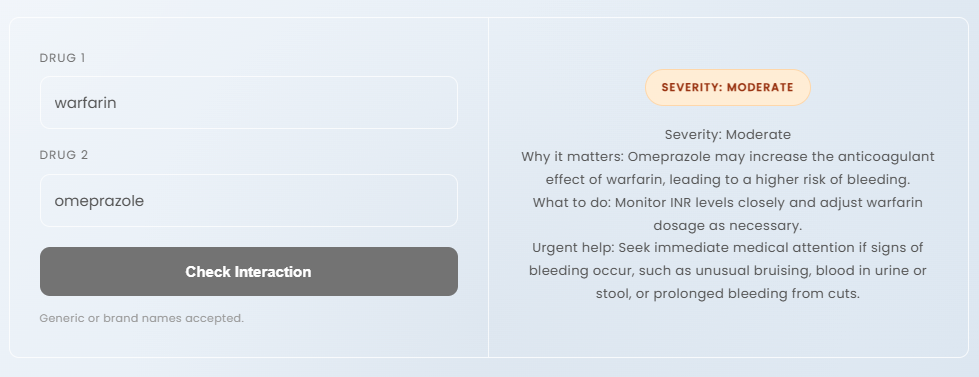
The system takes a mere 2 seconds to process queries. Users simply enter any two medicines—comfortably accepting both generic or brand names (e.g., matching warfarin and omeprazole).
The underlying AI architecture instantly processes the pair. Instead of printing cold database codes, it renders an animated, clean presentation panel that features:
- Dynamic Severity Color Coding: The interface immediately parses the result text to adjust an on-screen visual badge. It shifts to a Soft/Dark Red alert for High severity , an Amber layout for Moderate severity , and a Soft Green badge for Low or minimal interaction risk.
- Plain-English AI Guidance: The system reads the raw data behind the scenes and populates a highly readable summary box telling you exactly how the two medicines act together.
It is completely ad-free, completely free of account walls, and operates as the absolute fastest, cleanest patient safety tool available in 2026.
3. Drugs.com Interaction Checker
- The Longest-Standing Complete Consumer Database
- Link: Drugs.com Interaction Wizard
Drugs.com hosts one of the most trusted and reliable consumer-facing databases on the internet. Its tool scales impressively well, managing a massive registry of over 24,000 distinct prescription molecules, biological therapies, and wellness products. It partitions risk flags clearly into Major, Moderate, and Minor tiers, pairing each result with robust consumer explanations and deep-dive patient guides.
- The Catch: The structural layout of the web portal remains quite traditional. To check an entire medication box, a user must add items one by one, wait for specific auto-complete strings to load, and navigate around heavy on-screen advertisements. Furthermore, its legacy matching tables can occasionally run into rigid formatting issues when attempting to evaluate novel, unbranded custom supplements or modern combo-pills.
4. WebMD Interaction Center
- The Straightforward Lifestyle De-Risking Platform
- Link: WebMD Interaction Center
WebMD’s standalone tool targets general lifestyle de-risking. It excels at flagging foundational lifestyle interactions, explicitly detailing how specific medications clash with everyday foods and drinks (such as the impact of grapefruit juice on statin clearance, or the risk of mixing vitamin K-rich leafy greens with classic blood thinners like warfarin).
- The Catch: WebMD is built for broad-scale consumer reading. If a user is navigating an advanced, multi-tiered therapeutic regimen—such as balancing a modern GLP-1 weight loss injection with specialized cardiovascular, psychological, and bio-identical hormone therapies—WebMD’s generic insights can feel overly protective, frequently defaulting to generalized “consult your doctor” warnings rather than breaking down precise biochemical risks.
5. Epocrates Online Interaction Check
- The Point-of-Care Workflow Reference
- Link: Epocrates Online Portal
Epocrates is a classic bedrock of American point-of-care clinical practice. Its interaction utility focuses heavily on professional workflow optimization, ensuring that physicians and clinical teams can instantly screen complex polypharmacy profiles right at a patient’s bedside. It provides clean, un-embellished data points regarding safety boundaries, specific laboratory monitoring mandates, and alternative therapeutic options.
- The Catch: Epocrates is locked down inside a professional ecosystem. Accessing its elite-tier feature sets requires navigating commercial enterprise gates, paid membership tiers, or restricted credential validation steps, making it largely inaccessible for an independent patient running a routine at-home check.
A Technical Comparison Matrix
| Feature/Metric | Medscape | DrGuide.net AI Pharmacist | Drugs.com | WebMD | Epocrates |
| Processing Speed | 8–15 Seconds | 2 Seconds (Instant REST API) | 10–20 Seconds | 10–15 Seconds | 5–10 Seconds |
| Input Style | Multi-step Search | Clean Dual Fields (Brand/Generic) | List Assembly | List Assembly | Clinical Selection |
| Account Required? | Yes | No (Zero Sign-up Friction) | No | No | Yes |
| Visual Indicators | Text-Based Tiers | Smart Color-Coded Severity Badges | Color Boxes | Simple Text Tags | Minimal Text |
| Language Profile | Academic Clinical | Actionable Patient English | General Consumer | Simple Consumer | Strict Medical |
Patient & Consumer Safety FAQ
- Why do common dietary supplements regularly cause major medication interactions?Dietary supplements contain active biological compounds that are processed by the exact same liver pathways as prescription tablets. For example, St. John’s Wort accelerates the liver’s CYP3A4 metabolic enzyme. If you take it alongside an oral contraceptive or a blood thinner, your liver flushes out the prescription medication at double speed, rendering it entirely ineffective.
- Is it safe to simply space out interacting pills by a few hours?No. Spacing medications apart throughout the day can sometimes alleviate direct stomach irritation, but it does not stop systemic, liver-level interactions. If one drug permanently blocks a metabolic pathway or thins your blood, those physiological changes remain active in your system for hours or days, regardless of pill timing.
- What is the difference between a high, moderate, and low severity flag?
- High (Red): The combination is dangerous and carries an immediate health risk. It should generally be avoided unless specifically adjusted by a doctor.
- Moderate (Amber): The drugs can interact significantly. Closer monitoring, dose tracking, or timing adjustments are usually needed.
- Low/None (Green): The drugs are clinically stable to be taken together with minimal risk of overlapping side effects.
- Can an automated checker replace a human pharmacist or physician consultation?Absolutely not. Digital interaction checkers act as an immediate baseline safety triage tool. They serve to highlight critical red flags so you can bring specific, informed questions to your licensed medical team. Never stop or alter a prescribed clinical dose without explicit medical guidance.
- Why do some checkers flag an interaction that my doctor didn’t mention?Doctors often knowingly prescribe interacting medications if the clinical benefit outweighs the potential risk. In these cases, they will typically implement a specific monitoring plan, such as ordering routine blood work or adjusting dosages to safely balance the interaction.
- Does DrGuide.net accept brand names or only generic ingredient names? The engine smoothly accepts both brand and generic entries. For example, typing “warfarin” or its brand alternative will communicate with the exact same background safety database seamlessly.
- What should I do if an interaction checker flags my daily combo as “High Severity”?Do not panic and do not abruptly halt your primary maintenance medications. Contact your prescribing physician or local pharmacist immediately, show them the specific flagged interaction, and request a comprehensive medication review to explore safer therapeutic alternatives.
- Are over-the-counter pain relievers safe to mix with daily prescriptions?Frequently no. NSAID pain relievers (like Ibuprofen, Advil, or Aleve) interact significantly with blood pressure pills, diuretics, and antidepressants (SSRIs), drastically increasing the risk of sudden kidney stress or internal gastrointestinal bleeding. Always cross-reference OTC choices first.
- Why does DrGuide.net limit inputs to two items instead of a massive list? By focusing on direct pairs (Drug 1 and Drug 2) , the backend eliminates system errors and avoids generating a confusing wall of text. This keeps the triage tool incredibly clean, laser-focused, and fast for checking a specific interaction doubt in two seconds flat.
- How does DrGuide.net run complex checks so much faster than legacy portals? Legacy portals rely on a multi-step user flow: loading individual database queries, matching exact text strings, and populating multiple page layouts. The DrGuide.net AI Pharmacist uses an optimized asynchronous REST fetch protocol. It streams your two entries directly to an AI handler and flashes the response onto your screen with zero page-reload latency.